Showing posts with label Suffering. Show all posts

7.24.2013

Book Review: “The Epic of God”

Last night I finished reading Michael Whitworth’s The Epic of God, which is a guide to the Book of Genesis (rather than a full commentary), and it was a really good book.

The Epic of God is not written to be a scholarly commentary, and there’s absolutely nothing wrong with that. In fact, I would argue that what Whitworth has done is equally if not more valuable: he has produced a text which is informed and supported by scholarship (it is a well-researched book) but is easily read and understood by the average Christian. This is an important accomplishment, and I am always appreciative of efforts which bridge the gap between the church and the academy.

Anyway, I wrote a somewhat more in-depth review on the book’s Amazon page, but here I just wanted to do what I enjoy—share good quotations! Here they are (with my comments in brackets):

“After Adam was created and placed in Eden, he was given the task of working and keeping the garden. Work is often though to be a consequence of the Fall, but notice that in the perfect world that God created, man was created to work as a means of glorifying the Lord.” (26) [Amen! Work is a good thing!]

“Sin is not a blunder we can flippantly dismiss with ‘Everyone makes mistakes.’ A mistake is wearing two socks that don’t match; sin is an offense and abomination against a holy God. Our sins cost God the life of his Son.” (79)

“There is never an excuse to be selfish with God’s blessings.” (120)

“The God of Abraham has fixed an appointed time, unknown to all but him, when all suffering will come to a fantastic end! It will be the moment when the Son comes to be glorified with his church and render awestruck all who have put their faith in him…knowing that our heartache will eventually give way to hallelujahs can help us bear the pain a little while longer. God sees. God knows. God cares. He has appointed a time when he will visit his people in their distress and bring with him the redemption of the ages!” (165) [One of the definite strengths of the book is the way the author ties the story of Genesis into God’s greater story of the redemption and salvation of his creation.]

“And this is the truth that Abraham discovered on that occasion, that God’s commitment to justice is greater than our own…But his commitment to mercy is equally greater than our own.” (167-68)

“The life of faith is an odyssey of unexpected twists and turns.” (190) [This has certainly been true in my life!]

“If you are having difficulty surrendering to God what is most valuable to you, perhaps you have never acknowledged it as coming form him to begin with.” (215) [Ouch.]

“Prayer is for our benefit, not God’s. Praying for something that is in the will of God shapes us spiritually in ways few other things can. God’s desires become our own, and we start to see things as he does.” (232-33)

“It is natural and healthy for parents to want their children to succeed in every area. But what shall it profit a child if he becomes a Rhodes scholar or wins the Heisman trophy, yet loses his soul? (303) [Yeah, I wish every youth group parent I have or will ever have would read this quote about three times a day.]

“It is not healthy, not does it deepen our faith, to play the what-if game…when we find ourselves in the throes of suffering and pain, we must refuse to play the what-if game. Ask instead, ‘What if God is greater than my current circumstances? If God is indeed working out a plan to bring himself greater glory, how should I react?’ Then respond accordingly, confident that he can use our disappointments to deepen our faith and bring our lives into greater harmony with him.” (327) [This was very helpful for me to read, as I struggle with playing the what-if game.]

“We frail and pathetic humans have a bad habit of gauging God’s presence based on our circumstances…But veterans of the life of faith know that circumstances are no better a barometer of whether God is with you than overcast skies are proof that the sun has vanished completely.” (329) [Wow.]

I know that was a lot of quotations, but like I said, it was a really good book! The Epic of God will  deepen your understanding of the Book of Genesis, but more importantly, it will deepen your faith as well!
8.29.2011

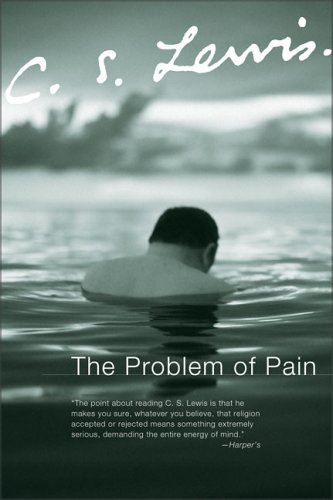
The Problem of Pain

I just finished reading C.S. Lewis’s The Problem of Pain, and rather than wait six months to write about a book like I normally do, I thought I’d go ahead and post some brief thoughts.


Compared to some of his other works (Narnia, Mere Christianity, The Screwtape Letters), The Problem of Pain really wasn’t my favorite—parts of it are somewhat hard to follow, there’s a semi-weird chapter on animals, to an extent, he seems to undermine the doctrine of the Fall, and he also suggests a Christology that is lower than I am comfortable with.

Nevertheless, it’s still C.S. Lewis, which means that there is a lot of good stuff in The Problem of Pain. Below are some quotations that I particularly enjoyed…

Free will necessitates suffering:
“Try to exclude the possibility of suffering which the order of nature and the existence of free wills involve, and you find that you have excluded life itself.”
(Lewis, p. 25)
On what we wish God was like:
“What would really satisfy us would be a God who said of anything we happened to like doing, ‘What does it matter so long as they are contented?’ We want, in fact, not so much a Father in Heaven as a grandfather in heaven—a senile benevolence who, as they say, ‘liked to see the young people enjoying themselves’, and whose plan for the universe was simply that it might be truly said at the end of each day, ‘a good time was had by all’.”
(p. 31)
One of the more famous C.S. Lewis quotes that I had heard and like before but never knew where it came from is found in The Problem of Pain:
“A man can no more diminish God’s glory by refusing to worship Him than a lunatic can put out the sun by scribbling the word ‘darkness’ on the walls of his cell.”
(p. 46)
Lewis suggests and then explains what he calls “the humility of God”:
“…It is a poor thing to strike out colors to God when the ship is going down under us; a poor thing to come to Him as a last resort, to offer up ‘our own’ when it is no longer worth keeping. If God were proud He would hardly have us on such terms: but He is not proud, He stoops to conquer, He will have us even though we have shown that we prefer everything else to Him, and come to Him because there is ‘nothing better’ now to be had…It is hardly complimentary to God that we should choose Him as an alternative to Hell: yet even this He accepts.”
(pp. 95-96)
Is it suffering of good people the hardest thing to explain? For Lewis, the answer is “no”:
“The sacrifice of Christ is repeated, or re-echoed, among His followers in very varying degrees, from the cruellest martyrdom down to a self-submission of intention whose outward signs have nothing to distinguish them from the ordinary fruits of temperance and ‘sweet reasonableness’. The causes of this distribution I do not know; but from our present point of view it ought to be clear that the real problem is not why some humble, pious, believing people suffer, but why some do not.”
(p. 104)
On the Christian’s submission of his own will:
“Christian renunciation does not mean stoic ‘Apathy’, but a readiness to prefer God to inferior ends which are in themselves lawful. Hence the Perfect Man brought to Gethsemane a will, and a strong will, to escape suffering and death if such escape were compatible with the Father’s will, combined with a perfect readiness for obedience if it were not.”
(p. 113)
An allusion to the “least of these” passage in Matthew 25 and the ethical implications of following Jesus:
“In the fullest parabolic picture which He gave of the Judgement, Our Lord seems to reduce all virtue to active beneficence: and though it would be misleading to take that one picture in isolation from the Gospel as a whole, it is sufficient to place beyond doubt the basic principles of the social ethics of Christianity.”
(p. 114)
And in reference to the flak that Christians often take for their hope of heaven (I love this quote):
“We are very shy nowadays of even mentioning heaven. We are afraid of the jeer about ‘pie in the sky’, and of being told that we are trying to ‘escape’ from the duty of making a happy world here and now into dreams of a happy world elsewhere. But either there is ‘pie in the sky’ or there is not. If there is not, then Christianity is false, for this doctrine is woven into its whole fabric.”
(p. 149)
Of course, there are other good parts to the book, but the excerpts above at least give a taste of the book’s contents.

9.05.2008

Arthur Ashe On Suffering


Late in his life, during his battle with AIDS (he had contracted HIV during a blood transfusion), one of Ashe’s fans asked him, “Why does God have to select you for such a bad disease?”

Ashe replied:

“The world over, 50,000,000 children start playing tennis, 5,000,000 learn to play tennis, 500,000 learn professional tennis, 50,000 come to the circuit, 5,000 reach the Grand Slam, 50 reach Wimbledon, 4 to the semifinals, 2 to the finals. When I was holding a cup, I never asked God ‘Why me?’ And today in pain I should not be asking God, ‘Why me?’”

The Doc File © 2006-2012 by Luke Dockery

  © Blogger template 'Fly Away' by Ourblogtemplates.com 2008

Back to TOP