Showing posts with label Racism. Show all posts

7.09.2013

The Fall of Man and the Sociological Consequences of Sin

Aftermath of the Boston Marathon Bombing
In our continuing discussion of the Fall of Man in Genesis 3 and the widespread devastation of sin, we have already covered the theological and personal consequences of Adam and Eve’s misdeed; in this post we turn to the sociological fallout of that sin, or the way that sin affects our relationships with one another.

Returning to our text, we can see this dimension clearly played out in verses 11-13:
“[God] said, ‘Who told you that you were naked? Have you eaten of the tree of which I commanded you not to eat?’ The man said, ‘The woman whom you gave to be with me, she gave me fruit of the tree, and I ate.’ Then the Lord God said to the woman, ‘What is this that you have done?’ The woman said, ‘The serpent deceived me, and I ate.’”
People were created to live in community with one another. Specifically, Eve was created to be the perfect partner for Adam (Genesis 2.18-25). But when God confronts Adam and Eve with their sin, something very significant (and unfortunate) happens: the unity that had previously existed between Adam and Eve is shattered as Adam immediately blames his wife for the sin which they had committed together.

This brings a conflict and disharmony between them that would be passed down over time (Genesis 3.16), and we can see it unfold in the pages of Genesis in the accounts of numerous broken relationships—Cain’s murder of his brother, the depraved society of Sodom and Gomorrah, the distorted relationships between Sarah and Hagar, Jacob and Esau, Jacob and Laban, Joseph and his brothers, and more. But the problems certainly don’t stop there—this same conflict and disharmony continues to darken and distort our world today.

Our world is deeply flawed by sin, and this manifests itself everyday sociologically, as we treat one another in a wide array of horrible, messed up ways:
  • On an international level, countries wage war and kill because of conflict over ideology or resources.
  • Systemic evils such as poverty, abortion, racism, sex trafficking, government corruption, lotteries, and more stem from our exploitation of our neighbors in order that we might obtain our own selfish desires.
  • Horrific acts of incomprehensible violence fill our news cycles. Mass shootings at elementary schools, the use of passenger airliners as terrorist missiles, bombings at marathon finish lines and incomprehensible barbarity at soccer matches shock and dismay us and cause us to weep.
  • Our interpersonal relationships are also a mess. Dishonesty, reckless ambition, and violence abound. The (supposedly) lifelong bonds of marriage are broken on a whim.
And the sum result: our society as a whole stagnates and decays, as people live lives marked by self-interest and fear of one another. The community for which we were created is broken.

Sin destroys our relationships with one another.

5.03.2013

Destroying the Works of Satan


A couple of weeks ago I had the opportunity to speak at a youth rally and my topic was the purpose of the church. I talked about how the church is God’s vehicle for saving the world today (through the preaching of the gospel), for influencing the world and trying to make it a better place (through service), and equipping Christians for those first two tasks (through education and discipleship).

And those are all pretty standard ideas—we hear about those things a lot when we talk about what the church should do. But the church has another important purpose that is often neglected in such discussions: the mission of the church is to oppose and destroy the works of Satan.

In 1 John 3.8, John said that Jesus came to earth so that “He might destroy the works of the devil.” In Ephesians 6.12, Paul says that our struggle as Christians is not against flesh and blood, but against the forces of darkness. 

These verses make it clear that as the church, we are a part of a spiritual battle against Satan and his influence. Moral corruption and sin are the works of the Devil (and we focus on things like that a lot),  but so are things like disease, starvation, poverty, terrorism, and racism. 

When you look at all the sad and messed up stuff that happens in our world—do you think God likes that stuff? Of course not! Children starving to death in the developing world, or innocent people being killed because of racial wars, or bombs going off at marathon finish lines—those are works of Satan, and when we take part in efforts to fight against those things, we are fulfilling the purpose of the church in opposing and destroying the works of the Devil. 

To me, realizing that when we fight against evil, we’re part of a cosmic struggle and are fighting against Satan himself gives us a whole new level of motivation for doing it. The decisions we make each and every day are important because we have the opportunity to stand up against evil. 

A cosmic struggle against evil: think about that the next time one of your friends tells a racist joke—are you going to sit there and laugh at the works of Satan, or realizing that God loves all people regardless of race and that racism comes from Satan, are you going to speak up and put a stop to it? 

Or the next time you have an opportunity to give to people, maybe people living on the other side of the world who have less than you do—are you going to be willing to use what you have to fight against the works of Satan like poverty and starvation, or are you going to hold onto those things so you can continue to pursue the idolatry of the “American dream”?

Studies show that a whole bunch of teens leave the church after high school, and I think a big reason for that is because it just doesn’t seem like the work of the church is all that important. After all, if we narrow down what church is to only a couple hours of activity a week, of course its importance is going to be diminished. But when we realize the cosmic nature of the struggle we are involved in—saving the world, serving the world, training Christians to do those things, and opposing the works of Satan—we see that the church is absolutely a cause worth giving our lives to.

If you liked this post or found it to be challenging or helpful, please share it with others by clicking on one of the buttons below. Thanks!

3.06.2013

Daring and Determination in the Christian Walk

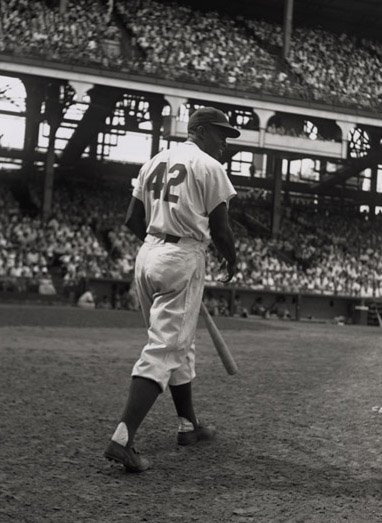
As any regular readers of The Doc File know, I am a huge fan of Jackie Robinson. In addition to being a world-class athlete, Hall of Fame baseball player, and, behind Martin Luther King Jr., the most influential player in the American Civil Rights Movement, he was also a man of great personal character.

I recently came across the photo at the top of the page of Jackie on the base paths. It’s a picture I love because I think it so well captures two of Jackie’s characteristics which were integral to his success and are also necessary in the daily life of the Christian: daring and determination.

Daring
Integrating Major League Baseball left Robinson open to constant torment and abuse. Racist fans heckled and berated him constantly, opposing managers would threaten not to play the Dodgers if Jackie was in the lineup, and baserunners from other teams would try to spike him with their cleats. None of that was a surprise—Dodgers GM Branch Rickey had warned Robinson in detail of the kind of abuse he would face if decided to take part in the “Great Experiment” and become the player to break the color barrier in Major League Baseball—but Jackie Robinson was willing to take the risk.

In addition to his daring in integrating the big leagues in the first place, Robinson was also daring in the way he played he game. Bringing the style of the Negro Leagues to Major League Baseball, Robinson was a terror on the basepaths, stealing bases, distracting pitchers, and stealing signs.

Christians need to be daring as well. To a large degree, I believe a Christian’s influence in the world is nullified when she or he refuses to be daring. Doing things that make you feel uncomfortable like sharing your faith with a friend or co-worker or taking an unpopular moral stand when others refuse to requires daring. Being willing to attempt great things that you’re not sure you are capable of doing like adopting a child or teaching a Bible class also requires daring. Attempting to fulfill the mission given to us by Christ of seeking and saving the lost requires a great deal of daring!

Author John Augustus Shedd once famously said, “A ship in harbor is safe, but that is not what ships are built for.” It is a great quotation! Too often, I think that Christians look at the church as a safe harbor, and because they like the safety, they fail to venture outside of its (figurative) walls. Certainly the church is a safe place, but it should be a place where Christians are equipped to engage, change, and save the world, not where they can hide from it.

It’s not “safe” out in the world, but it is where our light is most needed. Christians must be daring!

Determination
In the picture above, the look in Jackie’s eyes oozes focus and determination. On the basepaths, he was completely locked in to his psychological and physical battle with the pitcher, and was determined to defeat him.

It’s interesting—baseball really wasn’t Robinson’s best sport. In college at UCLA, Jackie lettered in four different sports. In track and field, he won the national championship in the broad jump in 1940. In football, he led the nation in punt return average in 1939 and 1940 and led UCLA in rushing, passing, total offense, scoring, and punt returns in 1940. In basketball, Robinson led the Southern Division of the Pacific Coast Conference in scoring in both 1940 and 1941. Baseball was his fourth best sport! 

Later on, after spending some time in the military during WWII, Robinson honed his baseball skills playing in the Negro Leagues, but here’s the point I’m getting at: I’m really not sure that Jackie Robinson should’ve been a Hall of Fame caliber baseball player, but he was just so determined to succeed! Robinson knew that he carried the weight of the hopes of Black America on his shoulders, and he was determined that he would not let them down. So his determination led to great success.

Christians also need to be people of determination. You can’t accidentally live a faithful Christian life—it requires the determination on a daily basis to live a life of discipleship regardless of cost or consequence.

That’s counter-intuitive for us today (especially the part about cost or consequence) because we live in a consumer culture where different products are constantly vying for our attention and loyalty—if you’re not losing enough weight on your diet, quit it and try a new one. If you don’t like your cell phone plan, drop it and switch over to a competitor. If going to church doesn’t seem to be improving the quality of your life, cut it out and try something else…when taken to the extreme, we become people devoid of commitment or determination, and, quite simply, people who give up too easily. 

It is not easy to be a Christian, but Jesus never promised that it would be. Faithful discipleship requires determination!

Jackie Robinson’s ability to change the world certainly involved his natural talents and abilities, but equally if not more important were his character traits of daring and determination. If Christians, as citizens of the Kingdom of God are going to engage the world and change it for good, then we have to possess those same characteristics in abundance.

6.29.2012

Branch Rickey’s Original Plan for Integrating Baseball

Baseball historian John Thorn has written a fascinating article on a forgotten piece of baseball history—Branch Rickey’s master plan to integrate Major League Baseball.

Of course, we know the integration of MLB through the collaborative efforts of Rickey and Jackie Robinson was an unqualified success, but it didn’t go the way Rickey originally intended:
“…Rickey had never planned for one black man to deal with all the problems [of integrating the game] alone; he had meant to announce the simultaneous signing of several others.”
You can read the rest of Thorn’s article here.

4.24.2012

Martin Luther King Jr. and Jackie Robinson


Last week I wrote about Jackie Robinson’s integration of Major League Baseball in 1947 and mentioned that, after Martin Luther King Jr., Robinson was the most important figure in the American Civil Rights movement.

Today, while reading an article (which I recommend, by the way) about Jackie’s widow, Rachel Robinson, I came upon this quotation about Robinson from Dr. King:
“Back in the days when integration wasn’t fashionable, he underwent the trauma and humiliation and the loneliness which comes with being a pilgrim walking the lonesome byways toward the high road of freedom. He was a sit-inner before the sit-ins, a freedom rider before the Freedom Rides.”

For more information regarding Robinson’s pioneering efforts in the field of Civil Rights, see this interesting blog post I came across.

Jackie Robinson and Martin Luther King Jr. receiving honorary
Doctor of Laws degrees from Howard University in 1957.

4.16.2012

Guts Enough Not To Fight Back: Jackie Robinson

Jackie steals home against Yogi Berra and the Yankees in the 1955 World Series.

As a general rule in college and professional sports, teams retire the jersey numbers of the all-time greats who played for them. For example, no Chicago Bull can wear number 23, because that was Michael Jordan’s number and it has been retired. No New York Yankee can wear number 3, because that was Babe Ruth’s number and it has been retired. If you play Major League Baseball, regardless of what team you play for, you can’t wear the number 42, because that was Jackie Robinson’s number, and it is the only number to be retired by Major League Baseball.*

Sixty-five years ago yesterday, on April 15, 1947, Jackie Robinson donned that number 42 Brooklyn Dodgers jersey and appeared in his first regular season Major League game, breaking baseball’s racial color barrier.**

Robinson’s Hall of Fame career and handled himself on and off the field opened doors for other black athletes in professional sports (and ultimately many other fields as well), and it has been said that only Dr. Martin Luther King Jr. accomplished more for the American Civil Rights Movement than did Jackie Robinson.

Before he signed a contract to play for the Dodgers, Robinson was called into the office of Team President and General Manager Branch Rickey. To give him a taste of what it would be like to be the only black player in the Big Leagues, Rickey spent three hours taunting and insulting Robinson, calling him every racial slur he could think of. Rickey then told Robinson that this is what he would face every day on the field, and that if he wanted it to work out, he would have to promise not to fight back or respond to insults of any kind for the first three years of his career.

Robinson, who possessed a fiery temperament and was very outspoken, was put of by this and asked, incredulously, “Mr. Rickey, are you looking for a player who is afraid to fight back?”

Branch Rickey replied, “No, I want someone with guts enough not to fight back.”

After some deliberation, Robinson agreed to Rickey’s terms, and he lived up to them on the field. When opposing baserunners tried to spike him when sliding into second base, he didn’t fight back. When fans and players yelled and cursed at him and even questioned his very humanity, he showed them how wrong they were by taking the moral high ground.

He had the guts not to fight back.

What Branch Rickey told Jackie Robinson reminds me of Jesus’ words in The Sermon on the Mount in Matthew 5:
“But I tell you, do not resist an evil person. If someone strikes you on the right cheek, turn to him the other also. And if someone wants to sue you and take your tunic, let him have your cloak as well. If someone forces you to go one mile, go with him two miles.”
The world tells us to stand up for ourselves when we are treated unjustly. It tells us to have the courage to fight back and not let others push us around. On the other hand, Jesus tells us to have the courage to show that we are different from the world because we don’t fight back, and He tells us to forgive others when they mistreat us.

Jesus wants followers with guts enough not to fight back.


•   •   •


* Yesterday, to commemorate the anniversary of Robinson’s first game as a Dodger, this prohibition was temporarily lifted as representatives from each Major League team wore number 42 in his honor.
**Contrary to popular belief, Robinson was not the first African-American to play in the Major Leagues. That honor goes to Moses Fleetwood Walker, who played for the Toledo Blue Stockings in 1884. Regardless of this, Robinson was the first African-American to play Major League Baseball in the 20th century, and it was his breaking of baseball’s color barrier that led to the permanent integration of the Major Leagues.

4.15.2010

The Best Day In Baseball History


This is an updated version of a post from last year.


Sixty-three years ago today, on April 15, 1947, Jackie Robinson integrated Major League Baseball.

Robinson’s 10-year career had an unquestioned and inestimable impact on the Civil Rights movement in the United States. In the words of Princeton professor and civil rights activist Cornel West:
“More even than either Abraham Lincoln and the Civil War, or Martin Luther King, Jr. and the Civil Rights movement, Jackie Robinson graphically symbolized and personified the challenge to the vicious legacy and ideology of White supremacy in American history.”
The skill and grace with which he played and the way he handled himself on and off the field forced many Americans to face difficult questions about race for the first time, and ultimately resulted in the changing of the hearts and minds of millions.

Jackie Robinson made baseball, in fact, what it had always claimed to be—the national pastime.

7.22.2009

Cry, The Beloved Country

I read Alan Paton’s Cry, The Beloved Country at the beginning of the summer and meant to write about it long before now, but then the summer busyness that comes with youth ministry set in and I’m just now getting around to it.

Simply put, this is one of my all-time favorite books. I love Paton’s poetic style of writing, and I thought the story was incredibly moving and powerful.

Cry, The Beloved Country is set in South Africa in the late 1940s, before apartheid, but certainly in a time of profound racial strife.

The main character in the book is Umfundisi Kumalo, an elderly Anglican priest (“umfundisi” is Afrikaans for “parson”) who leaves his native village to go to the great city of Johannesburg in search of his son Absalom, who he hasn’t seen or heard from in a long time.

Kumalo has never really been away from his village before, and the old priest is completely overwhelmed by the size of the city, and the different customs and behaviors he sees there.

The book touches on several heavy themes—racism, theology, politics, the breakdown of the native village, crime, environmental concerns, and others—but I just want to focus on one quote that I really liked.

While in Johannesburg, Kumalo becomes close friends with Umfundisi Msimangu, a younger priest who helps him in his search and comforts him as he endures one heartbreaking discovery after another. Time and time again, Msimangu goes out of his way to help Kumalo in any way that he can.

At one particular moment in the book, the old priest is so moved by the overwhelming love and kindness that the younger priest shows him that he begins to pay him a compliment. Kumalo tells Msimangu that he has never known anyone like him, but before he can go on, the young priest interrupts his compliment and rebukes him, saying, “I am a weak and sinful man, but God put His hands on me, that is all.”

I think there’s profound meaning there. Often, I think the world can be put off by Christianity because people assume that Christians consider themselves to be better than everyone else (and certainly some do).

Instead, we should have the attitude of Msimangu. He wasn’t willing to take credit for his good deeds, but instead said that it was God’s influence in his life that made those deeds possible. That’s how we should be. We should strive to show the world that any difference or “betterness” on our part isn’t because of us—it’s because Jesus changes our hearts and allows us to be different.

“I am a weak and sinful man, but God put His hands on me, that is all.”

4.15.2009

Happy Jackie Robinson Day!


Sixty-two years ago today, on April 15, 1947, Jackie Robinson integrated Major League Baseball.

Robinson’s 10-year career had an unquestioned and inestimable impact on the Civil Rights movement in the United States. The skill and grace with which he played and the way he handled himself on and off the field forced many Americans to face difficult questions about race for the first time, and ultimately resulted in the changing of the hearts and minds of millions.

I’ve written more on Jackie Robinson here, but I just wanted to take note of today’s significance.

11.05.2008

The New President


I’m getting pretty tired of political posts—hopefully after I get the series on abortion finished up we can talk about more pleasant things for a while.

But first, even though I’m not a supporter of Barack Obama, I would be remiss if I didn’t say something about last night’s historic election.

It’s pretty amazing that just 40 years removed from segregation and lynchings, the American people have chosen an African-American as the next President of the United States, and the fact that he’s not my ideal candidate for the first black President does nothing to change that.

I disagree with many of Obama’s positions, but I don’t think that his election is the end of the world. I tend to think that many of the fears that people have concerning an Obama presidency won’t come to pass. I certainly hope that’s the case.

The ideas of change and hope have been a big part of Obama’s campaign. For my part, I hope that it is more than just political rhetoric, and that he works to bring about the unity and lasting peace that he talked about so much.

5.09.2007

My Skin is Yellow

During my last year at Harding, while I was taking graduate classes, playing ultimate and waiting for my wife-to-be to graduate, I also worked at Sidney Deener Elementary as an ESL Teacher.

With ESL (English as a Second Language), the emphasis is on getting non-native speakers to learn English, so technically, you don’t really need to be able to speak the native language of the students you work with. But it does help to be able to understand their language, and since most of the ESL students were from Spanish backgrounds and I was a former Spanish major, they offered me the job.

I did have one student who did not speak Spanish. His name was Phong, and he was a second grader from Vietnam. Phong was very smart—he was a math whiz and excelled at all kinds of logic puzzles, but when I met him, he had an English vocabulary of about 20 words. Needless to say, he was my most challenging student.

I worked with Phong every day for the next six months or so, and although I enjoyed all of my students (with Searcy not exactly being a multi-cultural mecca, I only had seven students in all), he quickly became my favorite. Getting to know him better and witnessing how much progress he made in learning English was easily one of the more rewarding experiences of my life, and it gave me some insight as to why teachers like to teach.

But Phong gave me some insight into other things too.

Like any other elementary student, Phong had a spelling list each week, and every week we would do various activities to help him understand the meanings of the words he was learning to spell and incorporate them into his working vocabulary. Towards the end of my time with him, he was capable enough with English that I would have him demonstrate his understanding of the meaning of each spelling word by using it in a sentence.

That’s what we were doing one morning when Phong came to the word “yellow.” He paused and looked around for a minute, and then smiled and exclaimed:

“Yellow. My arm is yellow.”

I remember being a little taken aback. After all, we’re not supposed to refer to people in colors, right? Describing someone as “black” inconsistently draws disapproving looks, glorifying someone for being “red” generally leads to a school having to change the name of a mascot, and everyone knows that referring to an Asian as “yellow” is offensive.

In this culturally-sensitive frame of mind, I was on the verge of correcting Phong when I realized: if he said his arm was yellow, who was I to tell him it wasn’t? I mean, it was his arm, and his skin was yellowish in a way, just as mine was whitish.

It didn’t bother him in the least to say that his skin was yellow or to realize that mine was white; he knew that we were different, but he also knew that the difference didn’t matter.

It seems to me that over the years, people generally have one of two reactions to the issue of race: either that racial differences are supremely important and even insurmountable, or that there are no differences at all.

I think Phong’s approach is more correct than either of these: we are different, but those differences don’t matter with respect to our value or worth as human beings.

This is also in line with the view that the Apostle Paul put forth Galatians 3.26-29:

“For you are all sons of God through faith in Christ Jesus. For all of you who were baptized into Christ have clothed yourselves with Christ.

There is neither Jew nor Greek, their is neither slave nor free man, there is neither male nor female; for you are all one in Christ Jesus.”


Paul wasn’t saying that there were no differences between Jews and Gentiles; he was saying that those differences are nothing when compared to the unity we share in Christ.

If we could come to the understanding of Phong, and of Paul, I think the world would be much better off.

4.15.2007

Guts

In college and professional sports, teams retire the jersey numbers of the all-time greats who played for them. For example, no Chicago Bull can wear number 23, because that was Michael Jordan’s number, and it has been retired. No New York Yankee can wear number 3, because that was Babe Ruth’s number, and it has been retired. If you play Major League Baseball, no matter what team you play for, you can’t wear the number 42, because that was Jackie Robinson’s jersey number, and it is the only number to be retired by Major League Baseball.

Sixty years ago today, on April 15, 1947, Jackie Robinson donned that number 42 Brooklyn Dodgers jersey and appeared in his first regular season Major League game.

Contrary to popular belief, Robinson was not the first African-American to play in the Major Leagues, but on that April day he did break baseball’s color barrier and became the first African-American to play Major League Baseball in the 20th century.

His Hall of Fame career and the way he handled himself on and off the field opened the door for other black athletes in professional sports, and it has been said that only Martin Luther King Jr. accomplished more for the Civil Rights Movement in the U.S. than did Jackie Robinson.

Before he signed a contract to play for the Brooklyn Dodgers, Robinson was called into the office of Team President and General Manager Branch Rickey. To give him a taste of what it would be like to be the only black player in the Big Leagues, Rickey spent 3 hours taunting and insulting Robinson, calling him every racial slur he could think of. Rickey then told Robinson that this is what he would face every day on the field, and that if he wanted it to work out, he would have to promise not to fight back or respond to insults of any kind for the first three years of his career.

Robinson, who possessed a fiery temperament and was very outspoken, was put off by this and asked, “Mr. Rickey, are you looking for a player who is afraid to fight back?”

Branch Rickey replied, “No, I want someone with guts enough not to fight back.”

And that’s exactly what Robinson did. When opposing baserunners tried to spike him when sliding into second base, he didn’t fight back. When fans and players yelled and cursed at him and questioned his humanity, he showed them how wrong they were by taking the moral high ground.

He had the guts not to fight back.

What Branch Rickey told Jackie Robinson reminds me of Jesus’ words in The Sermon on the Mount in Matthew 5: “But I tell you, do not resist an evil person. If someone strikes you on the right cheek, turn to him the other also. And if someone wants to sue you and take your tunic, let him have your cloak as well. If someone forces you to go one mile, go with him two miles.”

The world tells us to stand up for ourselves when we are treated unjustly. It tells us to have the courage to fight back and not let others push us around.

Jesus tells us to have the courage to show that we are different from the world because we don’t fight back, and He tells us to forgive others when they do mistreat us.

He wants followers with guts enough not to fight back.


Today, on the 60th anniversary of Jackie Robinson’s first game as a Dodger, representatives from each Major League team will wear number 42 in his honor.

The Doc File © 2006-2012 by Luke Dockery

  © Blogger template 'Fly Away' by Ourblogtemplates.com 2008

Back to TOP